
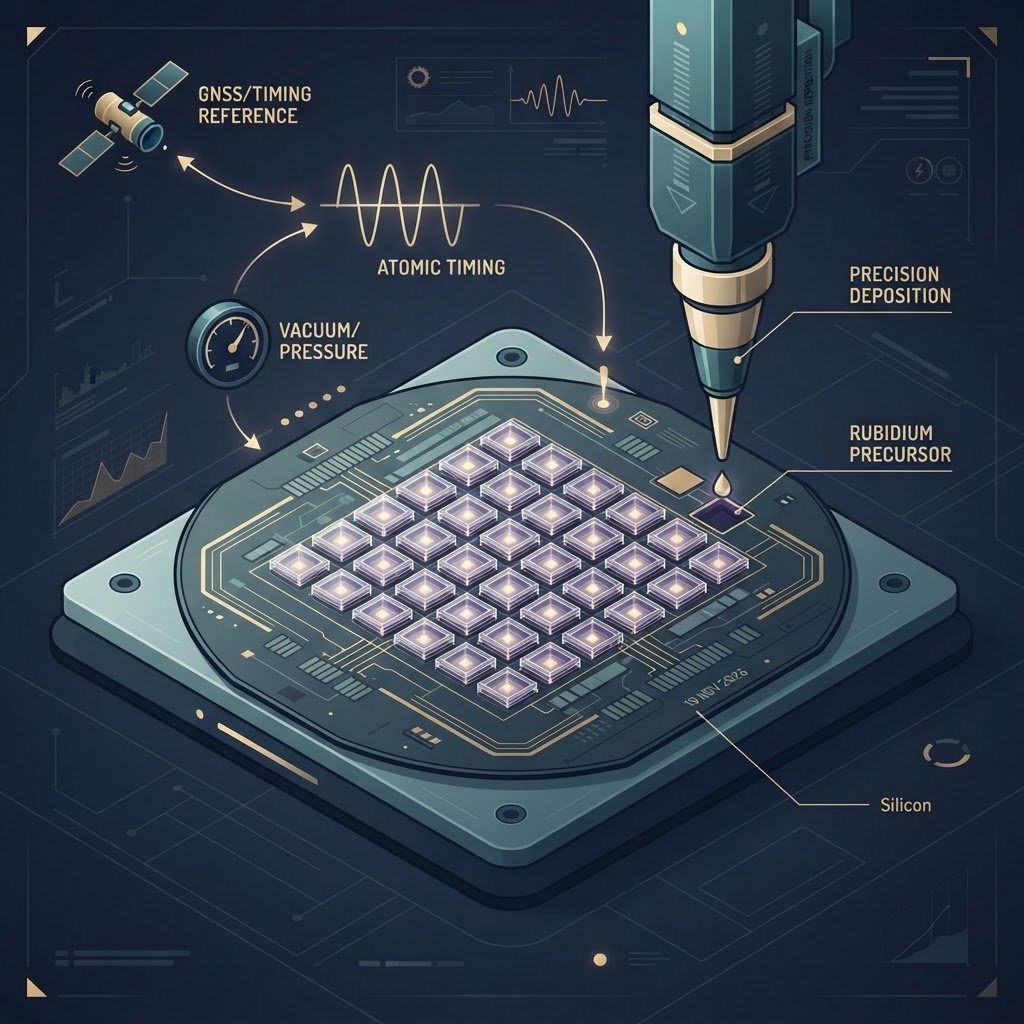
Japanese researchers have developed a new manufacturing platform for tiny atomic-clock components, using inkjet deposition to improve control over the gas inside microfabricated rubidium cells. The National Institute of Information and Communications Technology (NICT) announced the advance on November 19, 2026.
Working with Kyoto University, Tokyo Metropolitan University and industry partners, the team precisely deposited rubidium azide onto glass wafers. Heating the material generates rubidium vapor and nitrogen gas, allowing researchers to tune cell pressure while retaining wafer-level manufacturing compatibility.
Why it matters: Better control of these miniature cells could accelerate development of compact, accurate clocks for communications synchronization, satellite systems and backup navigation timing. This is a manufacturing research advance, not a commercial product launch.
Official source: NICT research announcement, November 19, 2026.




Leave a Reply